
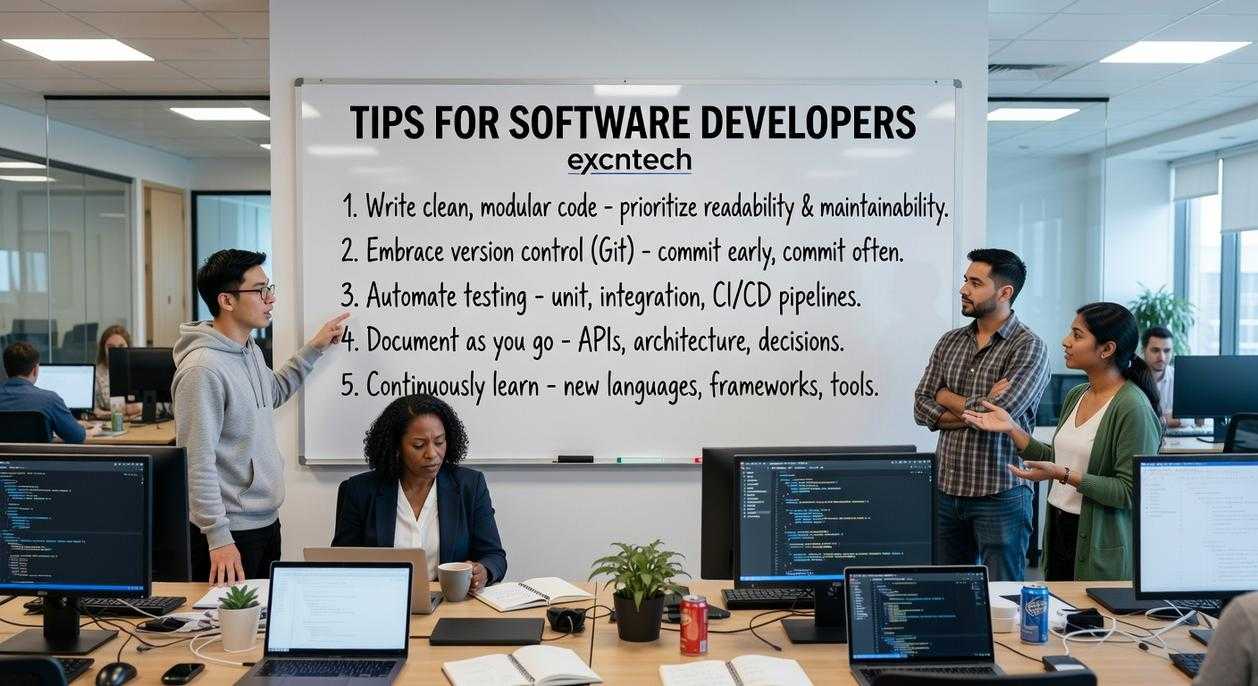
I’ve been writing code long enough to know that what worked two years ago won’t cut it today.
You’re probably here because you feel it too. The gap between what you learned and what you actually need to build modern software keeps growing.
Here’s the reality: AI is changing how we write code. Security threats are getting smarter. And the old playbooks? They’re outdated before they’re even published.
I spent months pulling together what actually matters right now. Not theory from textbooks. Real practices that work when you’re shipping production code.
This article gives you the tips for software developers excntech that matter in 2024 and beyond. I’ll show you what to focus on and what to ignore.
We’ve synthesized principles from high-performance computing, MLOps, and modern security protocols. This isn’t just web development basics. It’s what you need when you’re building systems that actually scale.
You’ll learn concrete practices you can use tomorrow. Better code patterns. Smarter workflows. The kind of skills that move your career forward.
No fluff about the future of tech. Just what works now and how to apply it.
Foundational Excellence: Reinforcing the Core
You’ve heard it a thousand times.
Write clean code. Keep it simple. Make it readable.
And sure, those principles still matter. But I’m going to be honest with you. They’re not enough anymore.
Some developers will tell me I’m overthinking this. They say if your code works and another person can read it, you’re done. Ship it and move on.
I used to think that way too.
But here’s what changed my mind. I watched projects that started with “clean enough” code turn into maintenance nightmares within a year. The kind where nobody wants to touch anything because one change breaks three other things.
The real issue isn’t just readability. It’s what happens when your codebase scales and your team grows.
Let me show you what I mean.
Version control is where most teams stop too early. You commit your changes with a decent message and call it a day. But modern software development Excntech requires more discipline than that.
I’m talking about trunk-based development if you need fast integration cycles. Or GitFlow when you’ve got strict release schedules to manage. The key is making your commits atomic with clear, imperative messages. This isn’t busywork. It makes code reviews faster and automated changelog generation actually useful.
Quality gates can’t be optional anymore. Integrate tools like SonarQube and security scanners right into your CI/CD pipeline. Make them mandatory before any merge happens.
Yes, this slows down your initial setup. But it stops broken code from ever reaching production.
Testing needs to cover the full pyramid. Unit tests for your logic. Integration tests for how services talk to each other. End-to-end tests for the flows users actually care about.
Pro tip: Treat code coverage as a guide, not a goal. Hitting 100% coverage with bad tests teaches you nothing.
Integrating AI and Machine Learning into Your Workflow
I’m not going to tell you that AI will replace developers.
That’s not what’s happening.
What I am seeing is this: developers who know how to work with AI tools are getting more done. The ones who ignore these tools are falling behind.
You’ve probably heard people say AI assistants write perfect code and you should just trust them. That’s wrong. Dead wrong.
These tools make mistakes. They suggest outdated patterns. They sometimes generate code that looks fine but breaks in production.
But here’s what I’ve learned after using them daily for the past two years.
Using AI Code Assistants the Right Way
Treat GitHub Copilot like a junior developer on your team. You wouldn’t blindly merge their pull requests without review, right?
Same principle applies here.
I use these tools to speed up the boring stuff. Boilerplate code, test scaffolding, API integrations I’ve done a hundred times. They’re great for that. By leveraging Excntech, I can effortlessly streamline repetitive tasks like boilerplate code and API integrations, allowing me to focus on the creative aspects of game development. By harnessing the power of Excntech, I can eliminate the tedium of repetitive coding tasks, freeing up my creative energy for the more innovative aspects of game development.
But I always read what they generate. I refactor it. I make sure I understand why the code works (or doesn’t).
The real skill now is prompt engineering. And yeah, I know that sounds like buzzword nonsense. But it’s just about being clear.
When I ask an AI assistant for help, I give it context. I show it examples of what I want. I specify my constraints upfront.
“Write a React hook that fetches user data” gets you generic code.
“Write a React hook that fetches user data from our REST API, handles loading states, and retries failed requests twice before showing an error” gets you something actually useful.
What You Need to Know About MLOps
You don’t need to become a machine learning engineer.
But if you’re building anything that touches AI, you need to understand some basics. Version control isn’t just for code anymore.
Your training data matters just as much as your algorithms. Tools like DVC let you track both together. When something breaks, you can trace it back to the exact dataset and code version that caused it.
I learned this the hard way when a model started giving weird results and I had no idea which data version it was trained on. Don’t be me.
The Ethics Part Nobody Wants to Talk About
Here’s something that makes people uncomfortable.
AI tools train on public code. Sometimes that code contains security vulnerabilities. Sometimes it contains biased logic. Sometimes it includes hardcoded credentials (yes, really).
You’re responsible for what ships. Not the AI.
I check generated code for privacy issues. I test for edge cases the AI might miss. I ask myself if the suggestions align with how we want to treat user data.
At excntech, we focus on building things the right way. That means being transparent when we use AI and making sure it serves users, not just our convenience.
Pro tip: Set up linting rules that catch common AI-generated antipatterns. Your future self will thank you.
The bottom line is simple. AI tools are here. They’re useful. But they’re tools, not replacements for thinking.
Learn to use them well and you’ll ship faster without sacrificing quality.
Advanced Protocols for Performance and Security

You know what kills me?
Developers who treat async programming like it’s some dark magic they’ll deal with “later.”
Later never comes. And then you’re stuck with an app that freezes every time someone uploads a file larger than a kitten photo.
I’m not saying you need to rewrite everything overnight. But if you’re still blocking I/O in 2024, we need to talk.
Master Async or Watch Your App Crawl
Here’s the deal with async/await patterns. They’re not optional anymore.
Your users don’t care that you’re running a synchronous database call. They just know your app feels slow and janky. And guess what? They’ll find one that doesn’t.
Pick your language. Python, JavaScript, C#, whatever. Learn the async patterns. Your future self will thank you when you’re NOT explaining to your boss why the app can’t handle more than 50 concurrent users. As you hone your programming skills and master async patterns, don’t forget to prioritize your digital safety by researching topics like How to Secure Your Computer Excntech to ensure your hard work remains uncompromised. As you dive deeper into mastering async patterns in programming, it’s equally crucial to explore resources on topics like “How to Secure Your Computer Excntech” to ensure that your innovative applications run smoothly and safely in today’s digital landscape.
Observability isn’t sexy. But you know what’s less sexy?
Spending three hours at 2 AM trying to figure out why production is on fire.
I see developers skip instrumentation because they’re “too busy shipping features.” Then they ship those features straight into a black box where nothing makes sense when things break.
Add structured logging from day one. Set up metrics. Get tracing in place. This is what separates the tips for software developers excntech from people who just pray their code works.
(Trust me, prayer is not a debugging strategy.)
Security Starts With You
Some developers think security is the security team’s problem.
WRONG.
You wrote the code. You own the security. End of story.
Scan your dependencies. I don’t care if that npm package has 10 million downloads. It could still have vulnerabilities that’ll get you breached.
And for the love of all that is holy, sanitize your inputs. SQL injection is older than most interns. There’s no excuse for it in production anymore.
Containers Done Right
Multi-stage Docker builds aren’t just a nice-to-have. They’re how you avoid shipping a 2GB image that takes forever to deploy and has 47 security holes.
Build lean. Scan everything. Then scan it again before it hits your registry.
Your production environment will thank you. Your security team will stop giving you the stink eye. And you’ll sleep better knowing you’re not one zero-day away from disaster.
Future-Proofing: The Practice of Continuous Innovation
You want to stay relevant as a developer?
Stop treating learning like something you’ll get to eventually.
I see developers all the time who think they can coast on what they learned three years ago. They’re the same people who panic when their stack becomes obsolete or when a new hire knows tools they’ve never touched.
Here’s my take. You need a system.
The 10% Innovation Rule
I dedicate 10% of my time to learning. Not when I feel like it. Not when a project demands it. Consistently.
Some developers say this is overkill. They argue you should learn on the job and that dedicated learning time is wasteful. I disagree completely.
Learning under pressure means you only pick up what’s immediately necessary. You never get ahead. You’re always catching up.
I explore new frameworks when nothing’s on fire. I read technical papers on advanced computing because I want to, not because a deadline forces me to. I contribute to open-source projects that interest me. I put these concepts into practice in Decoding Software Development Excntech.
This keeps my skills sharp. More importantly, it keeps me from becoming that developer who only knows one way to solve problems.
Documentation as a Deliverable
Here’s something most developers get wrong.
They treat documentation like an afterthought. Something to slap together before shipping.
I treat documentation as a core part of development. My READMEs are clear. My APIs follow OpenAPI standards. When I comment code, I explain why I made certain choices, not just what the code does.
(Anyone can read code and see what it does. The why is what matters.)
This approach ties directly into how to secure your computer excntech. Good documentation means your security practices are transparent and repeatable. Incorporating the latest strategies for safeguarding your gaming rig, especially through the insights provided by Excntech, ensures that your security measures are not only effective but also easily replicable over time. By leveraging the innovative techniques offered by Excntech, gamers can significantly enhance their security measures, ensuring their computers remain protected against evolving threats.
Pro Tip: Block out Friday afternoons for learning. No meetings. No urgent tasks. Just you and whatever new technology you’ve been curious about.
The developers who last in this field? They’re the ones who never stop being students.
Building the Future, One Best Practice at a Time
You now have a clear roadmap.
The practices I’ve covered span everything from foundational code quality to AI integration, performance, security, and personal growth. You know what matters and why it works.
Modern software development is complex. I get it. The landscape keeps shifting and it’s easy to feel overwhelmed.
But here’s the thing: ignoring these principles doesn’t make them go away. It just creates technical debt that haunts you later. Your career stagnates while the industry moves forward.
Tip for software developers excntech: Start small and build momentum.
When you adopt these practices systematically, something changes. You write better software. You solve problems faster. You become the engineer that teams want to work with.
This isn’t about perfection. It’s about progress.
Pick one practice from this guide right now. Just one. Commit to using it in your next project.
Maybe it’s writing cleaner functions. Maybe it’s adding better tests. Maybe it’s finally learning that AI tool you’ve been putting off.
Small improvements compound over time. That’s how you build excellence that lasts.
The code you write tomorrow can be better than the code you wrote today. You have the roadmap. Now use it.
 Fendric Eldwain has opinions about insider knowledge. Informed ones, backed by real experience — but opinions nonetheless, and they doesn't try to disguise them as neutral observation. They thinks a lot of what gets written about Insider Knowledge, Innovation Alerts, EXCN Advanced Computing Protocols is either too cautious to be useful or too confident to be credible, and they's work tends to sit deliberately in the space between those two failure modes.
Reading Fendric's pieces, you get the sense of someone who has thought about this stuff seriously and arrived at actual conclusions — not just collected a range of perspectives and declined to pick one. That can be uncomfortable when they lands on something you disagree with. It's also why the writing is worth engaging with. Fendric isn't interested in telling people what they want to hear. They is interested in telling them what they actually thinks, with enough reasoning behind it that you can push back if you want to. That kind of intellectual honesty is rarer than it should be.
What Fendric is best at is the moment when a familiar topic reveals something unexpected — when the conventional wisdom turns out to be slightly off, or when a small shift in framing changes everything. They finds those moments consistently, which is why they's work tends to generate real discussion rather than just passive agreement.
Fendric Eldwain has opinions about insider knowledge. Informed ones, backed by real experience — but opinions nonetheless, and they doesn't try to disguise them as neutral observation. They thinks a lot of what gets written about Insider Knowledge, Innovation Alerts, EXCN Advanced Computing Protocols is either too cautious to be useful or too confident to be credible, and they's work tends to sit deliberately in the space between those two failure modes.
Reading Fendric's pieces, you get the sense of someone who has thought about this stuff seriously and arrived at actual conclusions — not just collected a range of perspectives and declined to pick one. That can be uncomfortable when they lands on something you disagree with. It's also why the writing is worth engaging with. Fendric isn't interested in telling people what they want to hear. They is interested in telling them what they actually thinks, with enough reasoning behind it that you can push back if you want to. That kind of intellectual honesty is rarer than it should be.
What Fendric is best at is the moment when a familiar topic reveals something unexpected — when the conventional wisdom turns out to be slightly off, or when a small shift in framing changes everything. They finds those moments consistently, which is why they's work tends to generate real discussion rather than just passive agreement.